 November 11, 2026
Why I Think Reading Should Feel Like an Experience, Not a Task
Somewhere along the way, reading seems to have become another activity people are encouraged to measure. How many books have you finished?…
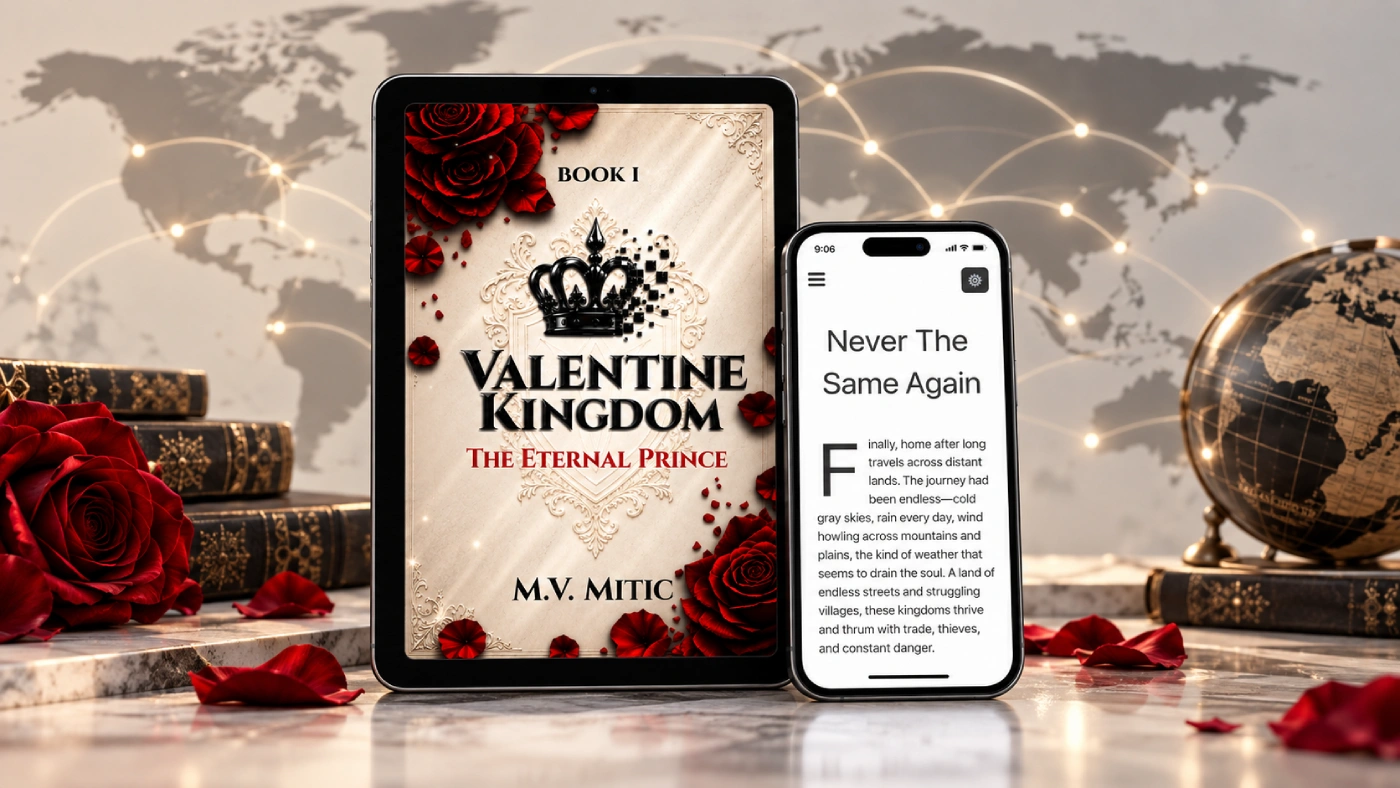
Valentine Kingdom was never meant to stay limited to one country or one language. From the beginning, I wanted the stories to reach readers from different parts of the world, regardless of where they lived or which language they preferred. One of the updates I wanted to complete early was making the reading experience more accessible internationally, and the Valentine Kingdom reader now supports more than 20 languages.
The structure remains the same: the same chapters, the same story and the same reading system. Readers can choose the language they are most comfortable using without needing to visit a completely different website or create another account. It is a simple feature on the surface, but I think it makes a meaningful difference when someone discovers the project from another country.
For me, multilingual support is not simply another feature to add to a list. It is part of how I want Valentine Kingdom to develop over time. I am creating a fictional world that can be explored by people with different backgrounds, and I do not want the website itself to introduce unnecessary limitations.
There is still work to do, and translations can always be improved. However, I prefer establishing a useful foundation now and continuing to refine it as the project grows.
I wanted to avoid creating separate websites or completely different versions of the reader for every language. That would introduce additional maintenance, make future updates more complicated and potentially create inconsistent experiences between readers.
Instead, the language options belong to the same reading system. The interface, chapter organization and general functionality remain familiar, while the available translations allow readers to experience the text in their chosen language.
I think that consistency is important. Someone reading in English should not receive a completely different application from someone reading in German, French or another supported language. The purpose of the language option is to make the story more accessible, not to divide readers into separate platforms.
This arrangement also makes development more manageable. When I improve the reader’s layout, navigation or another shared feature, those changes can benefit the same underlying platform rather than requiring a separate implementation for every language.
There are still language-specific details to maintain, of course. Translations need reviewing, text lengths can differ and certain interface elements may require adjustments. However, keeping the reading experience connected gives the project a clearer foundation for future development.
For me, that is preferable to building twenty different versions of essentially the same application.
Reading a novel is different from quickly browsing a website or checking a short piece of information. A reader may spend hours following characters, conversations, descriptions and events. Even someone who understands English reasonably well may prefer reading a complete fictional story in their native language.
I think this is particularly relevant for fantasy. A fictional world can contain unfamiliar names, kingdoms, traditions and ideas that readers need to understand while following the narrative. When the surrounding language is comfortable, it can be easier to concentrate on the story rather than constantly interpreting individual sentences.
There is also an emotional element to reading. Characters express fear, affection, uncertainty and other feelings through dialogue and narration. The way those experiences are communicated can influence how naturally readers connect with them.
That does not mean every translation can reproduce every detail of the original English perfectly. Languages have different structures, expressions and ways of communicating particular ideas. Translating fiction involves more than replacing individual words.
However, I believe providing a readable version in another language can make the story approachable to people who might otherwise never begin it.
For me, the objective is to preserve the characters, events and overall meaning while making the reading experience feel as natural as possible in each supported language.
One thing I wanted to preserve was the identity of the original story. Valentine Kingdom is a fictional world, and its characters, locations and history remain the same regardless of which language a reader selects.
Alexander is still Alexander. Elizabeth remains the same character, and the kingdoms, relationships and events do not change because the reader chooses a different language.
This matters to me because I want people from different countries to experience the same fictional world. The language should make the story easier to understand without turning it into a separate version with different events or altered character identities.
The original manuscript provides the foundation. Translations are intended to communicate that work to additional readers while preserving its narrative direction and essential details.
Of course, maintaining that consistency becomes increasingly important as more books are added. Names, recurring expressions and fictional terminology should remain recognizable throughout the series. A decision made in one chapter may affect how a later chapter needs to be translated.
I think establishing those conventions early can make future work easier. As Valentine Kingdom develops, the same fictional names and concepts will appear across multiple books, and consistency will help readers follow those connections.
The goal is not to create twenty different interpretations of the world. It is to make one connected world available through more languages.
The website, books and reader are all being developed with the same long-term idea in mind. I want Valentine Kingdom to work as an international publishing project rather than something designed exclusively for one market.
An author may live in one country, but that does not mean their stories need to remain there. Readers can discover books through search engines, social platforms, recommendations and articles from almost anywhere in the world.
Someone might encounter Valentine Kingdom while browsing on a phone in another country, without previously knowing anything about the author or the series. I want that person to have a straightforward way to explore the project.
Language support is one part of that experience. The website also needs to work across different devices, remain understandable to new visitors and provide a clear route toward the available books.
I do not think international publishing requires every feature to be developed separately for each country. A consistent central platform can serve readers from different regions while offering language choices where they are useful.
There may be additional regional considerations as the project develops, but I prefer approaching those as practical improvements rather than building an entirely different publishing operation for every audience.
For me, the important part is keeping the experience accessible while allowing the fictional world to maintain one recognizable identity.
Maintaining a single reading platform offers advantages beyond the language switcher itself. It allows the books, user accounts, reading preferences and future releases to remain connected within the same general system.
I wanted readers to have one familiar destination where they could access the available material. Creating separate language-specific websites would make that experience less straightforward, particularly for people who understand several languages or want to change their reading preferences.
There is also the matter of maintenance. Every additional independent website introduces its own configuration, potential technical problems and updates. Even relatively small differences can become difficult to manage when repeated across many versions.
With one connected reader, the central functionality can remain consistent. Navigation improvements, visual changes and accessibility adjustments can be developed for the platform as a whole.
That does not eliminate the work associated with multilingual content. Each translation still needs to be maintained, and changes to the original material may require corresponding updates. However, the technical foundation remains more manageable.
I prefer this approach because I want to spend more time developing the books and improving the reading experience than maintaining unnecessary copies of the same software.
One challenge of supporting multiple languages is that fiction cannot always be translated literally without affecting how it reads. A sentence that feels natural in English may become awkward when its structure is copied directly into another language.
Dialogue can be particularly sensitive. Characters have different personalities and ways of expressing themselves, and those differences should remain recognizable. A translation that communicates the literal meaning but loses the natural rhythm of a conversation may not provide the same experience.
Descriptions also require attention. Fantasy fiction often depends on atmosphere, whether a scene takes place in a forest, an old castle or somewhere unfamiliar. Word choices can influence how readers imagine the surroundings.
I think this is why translation should be treated as an ongoing part of the publishing process rather than something that is necessarily finished once a language becomes available.
Some passages may need refinement to improve clarity or preserve the intended tone. Recurring terms may need to be standardized, and feedback can help identify expressions that sound unnatural.
I do not expect every translation to become perfect immediately. I would rather recognize where improvements are possible and continue working on them than assume that supporting a language automatically means every sentence has reached its final form.
The important thing is maintaining the quality of the story while making progress toward broader accessibility.
Language is only one part of the reading experience. I also wanted the Valentine Kingdom reader to feel comfortable across different devices and screen sizes.
People read in different ways. Some prefer larger computer screens, while others spend most of their reading time on phones or tablets. The same story should remain accessible without requiring everyone to use identical hardware.
The reader’s page-based presentation is designed around moving through the text naturally, while navigation and appearance settings provide additional control over the experience.
I like keeping these functions straightforward. Readers should be able to open a chapter, adjust their preferences when needed and concentrate on the writing rather than constantly interacting with the interface.
Multilingual support adds another consideration because translated text can occupy different amounts of space. A sentence that fits comfortably in one language may require more room in another. The reader needs to accommodate those differences without becoming awkward to navigate.
For me, the goal is a consistent experience rather than identical visual spacing in every possible situation. What matters is that the text remains readable and the controls remain understandable.
The technology should support reading, regardless of whether someone chooses English or another available language.
I could have left international language support for a much later stage, after several books were available. However, I think there are advantages to considering it while the publishing platform is still developing.
Introducing multilingual support early encourages me to think about how the reader, translations and future books should work together. It is easier to establish a consistent approach before the collection becomes substantially larger.
For example, fictional names, chapter organization and interface terminology can be handled using shared conventions. Those decisions may appear small now, but they become more important when multiple books and languages are involved.
There is also an audience consideration. Readers from different regions may discover the project long before the series is complete. Providing language options earlier gives those visitors an opportunity to explore the opening story rather than requiring them to return at some unknown point in the future.
That does not mean every planned language or feature needs to be available immediately. I prefer introducing useful capabilities gradually while keeping the system flexible enough to accommodate later additions.
For me, this was an investment in the structure of the project, not simply a feature intended to make the website appear larger.
I do not consider the current language support to be the final version of the system. Like other parts of Valentine Kingdom, it can continue improving as I gain a better understanding of what readers need.
Translations may require corrections, certain expressions may become more consistent, and interface details may need refinement. Additional books will also introduce new material that needs to fit within the existing multilingual structure.
I think it is better to approach those developments as part of normal publishing maintenance. A digital reading platform is not something that needs to remain completely unchanged after its first release.
At the same time, I do not want updates to become constant distractions for readers. Improvements should make the experience more reliable and comfortable without unnecessarily changing familiar functions.
The central idea remains straightforward: one platform, one connected collection of stories and multiple language options.
As the project develops, I want readers to continue recognizing the same Valentine Kingdom environment even when additional features or books become available.
An international audience does not develop simply because a website offers several languages. Readers still need opportunities to discover the work, and the stories need to interest them once they arrive.
However, language options can remove one barrier for people who have already found the project. A visitor might discover an article or book description in English but prefer reading the actual novel in another language.
Providing that choice can make the difference between someone exploring the opening chapters and deciding that reading a complete book in English would be too uncomfortable.
I also think multilingual publishing can support longer-term audience development. As more people become familiar with the series, readers from different countries may recommend it to others who share their language.
That process takes time and depends on the quality of the experience. I would not assume that adding more languages automatically produces more readers, just as publishing more articles does not automatically guarantee traffic.
For me, the value lies in creating the possibility. When someone becomes interested in Valentine Kingdom, I want the reading platform to accommodate them wherever practical.
Valentine Kingdom is a fictional world with its own characters, kingdoms, landscapes and history. Those elements do not belong to one real country, and I do not want the reading experience to feel unnecessarily restricted by national boundaries.
The Eternal Prince introduces Alexander’s journey, but the world around him is intended to continue developing through future stories. As that collection grows, I want readers to have a familiar place where they can discover new books and return to the ones they already know.
Supporting more than 20 languages is one step toward that goal. It provides additional choices while preserving the central reading system and the identity of the original story.
There will always be things to improve. Translations can become more natural, the interface can become more comfortable and future releases will introduce new requirements. I see those changes as part of building the project rather than reasons to delay every feature until it is perfect.
What matters to me is making steady progress toward a reading experience that can serve people from different parts of the world without becoming unnecessarily complicated.
A reader in one country should be able to discover the same characters, follow the same chapters and explore the same fictional world as someone living somewhere completely different.
The language may change, but Valentine Kingdom remains the same.
For me, that is what makes multilingual support worthwhile. It allows one imagined world to become accessible to more people, while keeping the experience connected to the same place where the stories began.
November 11, 2026Somewhere along the way, reading seems to have become another activity people are encouraged to measure. How many books have you finished?…
 November 11, 2026
People often talk about reading goals as though finishing more books automatically means becoming a better reader. Read fifty books this year,…
 November 11, 2026
Digital reading has made books more accessible than ever. We can carry entire libraries on our phones, purchase ebooks almost instantly and…
 November 11, 2026
Have you ever noticed how much easier it is to enjoy a book when your surroundings feel comfortable? I think the environment…
 November 11, 2026
The beginning of a new year often creates pressure to make ambitious resolutions. Write an entire novel, publish several books, build a…
 November 11, 2026
Christmas attracts enormous attention from retailers, publishers and businesses offering seasonal promotions. Throughout December, customers encounter discounted products, gift recommendations and advertisements…
 November 11, 2026
Holiday travel often involves packing more things than expected. Clothes, gifts, personal belongings and everything else compete for limited space. Whether somebody…
 November 11, 2026
December seems like an attractive month to release a book. People are shopping for Christmas gifts, spending more time indoors and looking…
 November 11, 2026
Every winter, online stores begin advertising seasonal discounts, limited-time offers and holiday promotions. Books are no exception. A lower price can make…
 November 11, 2026
Holiday shopping has become increasingly dominated by electronics, subscriptions and products that often disappear from attention shortly after they are purchased. Every…
November 11, 2026Somewhere along the way, reading seems to have become another activity people are encouraged to measure. How many books have you finished?…
November 11, 2026People often talk about reading goals as though finishing more books automatically means becoming a better reader. Read fifty books this year,…
November 11, 2026Digital reading has made books more accessible than ever. We can carry entire libraries on our phones, purchase ebooks almost instantly and…
November 11, 2026Have you ever noticed how much easier it is to enjoy a book when your surroundings feel comfortable? I think the environment…
November 11, 2026The beginning of a new year often creates pressure to make ambitious resolutions. Write an entire novel, publish several books, build a…
November 11, 2026Christmas attracts enormous attention from retailers, publishers and businesses offering seasonal promotions. Throughout December, customers encounter discounted products, gift recommendations and advertisements…
November 11, 2026Holiday travel often involves packing more things than expected. Clothes, gifts, personal belongings and everything else compete for limited space. Whether somebody…
November 11, 2026December seems like an attractive month to release a book. People are shopping for Christmas gifts, spending more time indoors and looking…
November 11, 2026Every winter, online stores begin advertising seasonal discounts, limited-time offers and holiday promotions. Books are no exception. A lower price can make…
November 11, 2026Holiday shopping has become increasingly dominated by electronics, subscriptions and products that often disappear from attention shortly after they are purchased. Every…

Add the M.V. Mitic app to your device and start reading.