 October 25, 2026
A Halloween Reading Night for Two
A reading night for two sounds like a good Halloween plan to me because it leaves room for both company and quiet.…
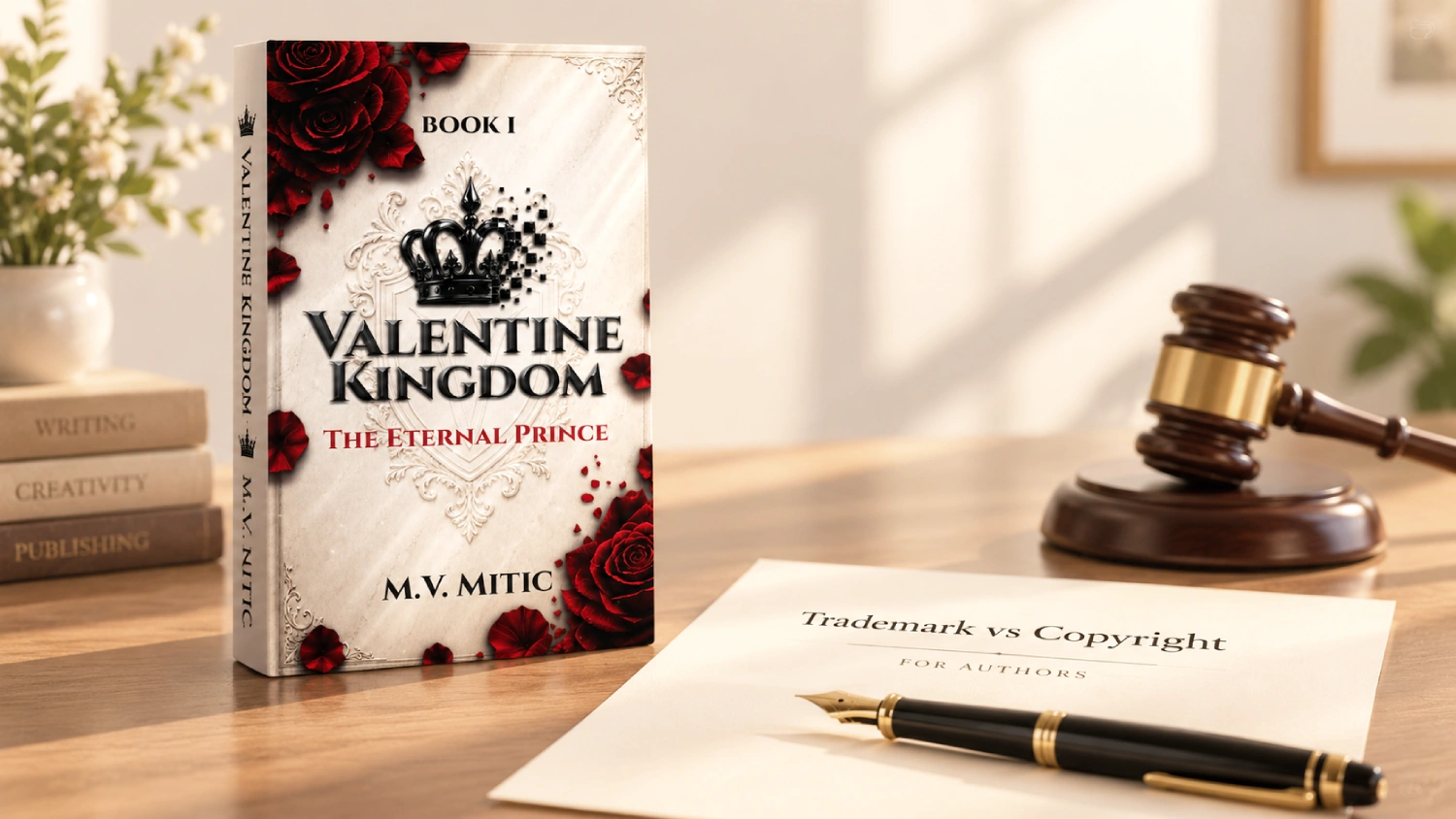
When I started thinking seriously about books as something larger than a single release, protection became much more important to me.
Writing the story is one part of the work. Building the name, visual identity, website, covers and everything around that story is another.
I do not think every author needs to turn publishing into a complicated legal project from the beginning. But I do think it is worth understanding the difference between protecting the work itself and protecting the identity that grows around it.
That is where copyright and trademarks begin to serve very different purposes.
Copyright is the part I naturally associate with the actual creative work.
The manuscript, chapters, artwork and other original material are the things that make the book what it is.
For me, that is the first layer.
If I spend months or years creating a world, characters and a story, I want that creative work to clearly belong to the person who created it.
That seems obvious, but I think authors sometimes focus so much on publishing that they forget to think about what happens after the book begins travelling beyond their own computer.
A book may later become an audiobook, collector edition, translation or something completely different.
The original work remains the foundation beneath all of those versions.
Trademark protection interests me for a different reason.
I think of it less as protecting one book and more as protecting the identity people begin to recognise.
A series name, publishing identity, logo or distinctive symbol can eventually become much larger than the individual story where it first appeared.
That becomes especially important when the same identity appears across websites, books, products, entertainment and other projects.
If someone sees the same name or symbol repeatedly, eventually they stop seeing it as decoration.
They recognise where it came from.
That recognition has value.
This matters even more to me when a story is intended to continue.
If an author plans to publish one independent novel and move on, the branding around it may never become particularly complicated.
A long series is different.
The name may stay for years.
The logo may appear on every edition. The website may use it. Readers may search for it directly. Future books may depend on people immediately recognising it.
At that point, I would rather think about protection early than discover years later that something important was ignored.
Not because every possible thing needs to be registered immediately, but because the decisions made early can become permanent later.
I also think consistency matters.
Changing a logo every few months, constantly redesigning the series identity or using different names everywhere makes it harder to build something memorable in the first place.
I prefer the opposite approach.
Choose the important elements carefully, then keep using them.
Over time, a simple name or symbol can accumulate meaning because readers have seen it repeatedly.
That is one reason I think branding and legal protection are connected.
There is little reason to protect an identity that you do not intend to keep.
But if something is going to represent your work for ten or twenty years, the decision becomes much more significant.
I still would not try to protect every tiny element immediately.
Authors can easily spend more time worrying about structures, registrations and paperwork than actually creating the work those systems are supposed to protect.
I think the important question is simpler:
What am I building that I genuinely expect to still matter years from now?
Those are the things worth paying attention to.
The manuscript matters.
The series identity may matter.
A permanent logo may matter.
A temporary campaign graphic probably does not deserve the same attention.
I do not really see copyright and trademark protection as alternatives.
They solve different problems.
Copyright concerns the creative work itself. Trademark protection becomes relevant to the identity surrounding that work and the way people recognise its source.
For an author building only one book, the balance may be simple.
For someone trying to build a long-running series, publishing identity or larger fictional world, I think both deserve consideration.
The story is worth protecting.
And if the name around that story becomes something readers remember, that may eventually be worth protecting too.
October 25, 2026A reading night for two sounds like a good Halloween plan to me because it leaves room for both company and quiet.…
 October 25, 2026
An ordinary room can become surprisingly unfamiliar after dark. During the day, I can see its edges, its furniture, and whatever is…
 October 25, 2026
When I imagine a gothic reading corner, I think about somewhere I would genuinely want to spend an evening. A comfortable chair,…
 October 25, 2026
There is a version of Halloween I like that involves very little preparation. A comfortable room, something good to read, a warm…
 October 20, 2026
One of the first things new authors encounter when preparing a book for publication is the ISBN. It appears on printed books,…
 October 20, 2026
Choosing the right book title can be surprisingly difficult. A title needs to fit the story, appeal to potential readers and remain…
 October 20, 2026
Finishing a manuscript can take months or years, so receiving an offer from a publisher is understandably exciting. Somebody wants to publish…
 October 20, 2026
A book cover is one of the first things a potential reader notices. Before somebody reads the description or opens the first…
 October 20, 2026
There are plenty of reasons why an author might prefer publishing under a different name. Some want privacy, others want a name…
 October 9, 2026
One thing I have never liked about social media is that having followers does not necessarily mean being able to reach those…
October 25, 2026A reading night for two sounds like a good Halloween plan to me because it leaves room for both company and quiet.…
October 25, 2026An ordinary room can become surprisingly unfamiliar after dark. During the day, I can see its edges, its furniture, and whatever is…
October 25, 2026When I imagine a gothic reading corner, I think about somewhere I would genuinely want to spend an evening. A comfortable chair,…
October 25, 2026There is a version of Halloween I like that involves very little preparation. A comfortable room, something good to read, a warm…
October 20, 2026One of the first things new authors encounter when preparing a book for publication is the ISBN. It appears on printed books,…
October 20, 2026Choosing the right book title can be surprisingly difficult. A title needs to fit the story, appeal to potential readers and remain…
October 20, 2026Finishing a manuscript can take months or years, so receiving an offer from a publisher is understandably exciting. Somebody wants to publish…
October 20, 2026A book cover is one of the first things a potential reader notices. Before somebody reads the description or opens the first…
October 20, 2026There are plenty of reasons why an author might prefer publishing under a different name. Some want privacy, others want a name…
October 9, 2026One thing I have never liked about social media is that having followers does not necessarily mean being able to reach those…

Add the M.V. Mitic app to your device and start reading.